Crafting a Long-Term Investment Strategy
By Ogechi Aguma ·


Long-Term Investment Planning: How to Build a Strategy That Stands the Test of Time
Most investors don’t fail because they choose the wrong stock. They fail because life gets busy, emotions take over and the plan loses structure. Long-term investing is not about perfection — it’s about building simple, repeatable habits that quietly compound in the background while you live your life.
A human approach to long-term planning
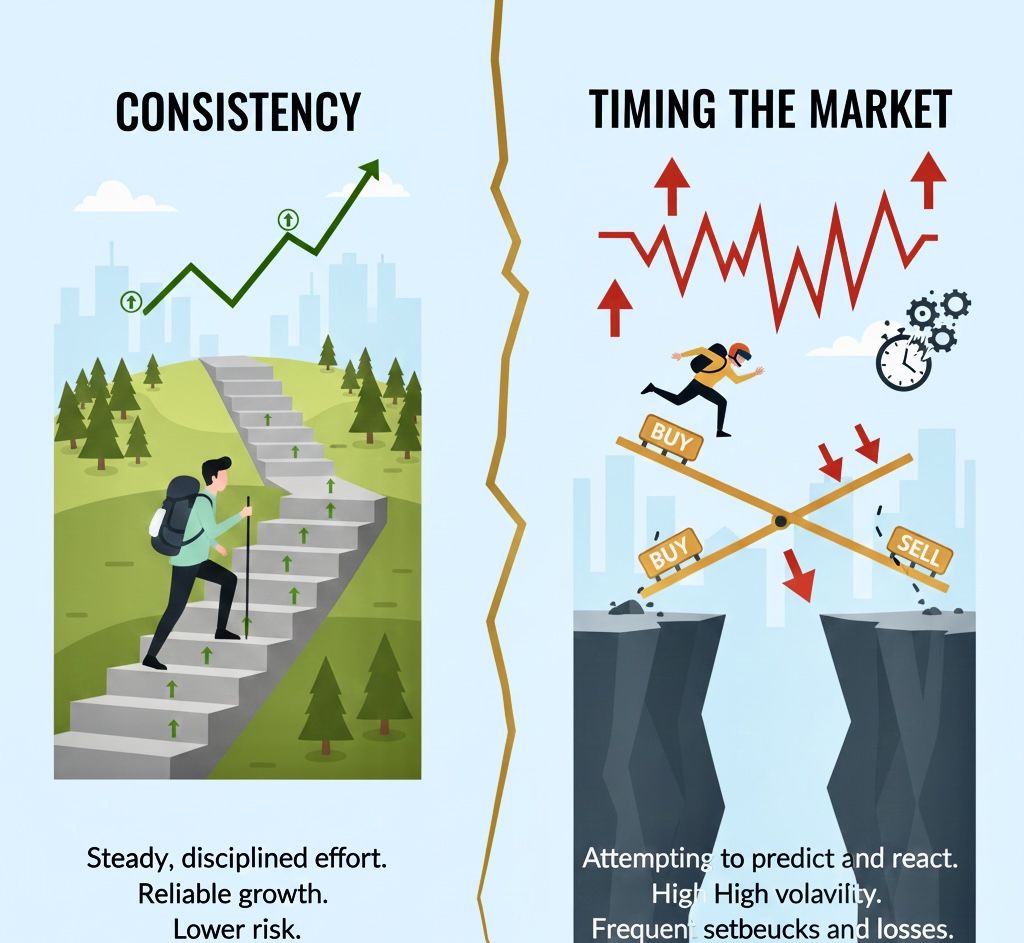
Forget the image of the expert who never makes mistakes. Real long-term investors look more like everyday people juggling families, work, stress, and uncertainty. They succeed not through prediction, but through consistency.
The truth is simple: people who give their investments time — and follow a process — tend to outperform those who jump in and out based on emotion. This has been proven in studies covering decades of market data.
The foundations that work for ordinary people
Research from Vanguard, Fidelity, and Morningstar shows that long-term success tends to come from five core habits:
- Clear goals. People who set specific targets (e.g., retirement at 60, children’s education) stay more consistent.
- Automatic contributions. Investors who automate monthly deposits usually accumulate far more over decades.
- Low-cost investment choices. Lower fees leave more money invested to compound over time.
- Diversification. Spreading risk across regions and sectors reduces the impact of downturns.
- Time in the market. Investors who remain invested through ups and downs tend to outperform those who try to time the market.
Asset allocation: the cornerstone of long-term performance
Studies have consistently shown that asset allocation — the mix of equities, bonds and other assets — explains most long-term portfolio returns.
Younger investors often embrace more equities because they have time to recover from volatility. As people age, they typically prefer stability and gradually shift toward lower-volatility assets. The important part is alignment between your time horizon and your mix of assets.
Making compounding work for you
To understand the power of consistency, consider this model:
- Monthly contribution: £1,000
- Investment period: 30 years
- Modelled annual return: 7%
Total contributions equal £360,000 — yet compounding could grow this to roughly £1,000,000. This demonstrates why behaviour and discipline often matter more than choosing “the perfect moment” to invest.
Practical, relatable steps that real people use
- Automate first, think later. Set up monthly contributions that leave your account automatically. This removes emotion and excuses.
- Create a simple rule. For example: “I invest on the 1st of every month, regardless of the market.”
- Review once a year. Not daily, not weekly — annually. This reduces stress and supports long-term discipline.
- Keep fees low. Lower costs have a meaningful impact over time; evidence repeatedly shows they improve long-term outcomes.
- Stay focused on your horizon. Short-term market noise often feels dramatic but rarely matters over decades.
A long-term mindset
Long-term investing is not a sprint — it is a routine. It is the quiet discipline of building something that your future self will thank you for.
Think of your long-term plan as planting seeds: individually they seem small, but with time and care they grow into something substantial and resilient.
Stay informed. For more educational insights on investing and financial habits, follow us on our social platforms:
“It’s more than money, it’s a lifestyle.”
© Shares Investment Lifestyle — Educational content for long-term financial understanding. Visit sharesinvestmentls.com.
This guide is general education, not financial advice. Investments can fall as well as rise. If you are unsure, speak to a regulated financial adviser.