Consistency vs Timing: Why Waiting for “The Right Time” Keeps You Poor
By Ogechi Aguma ·
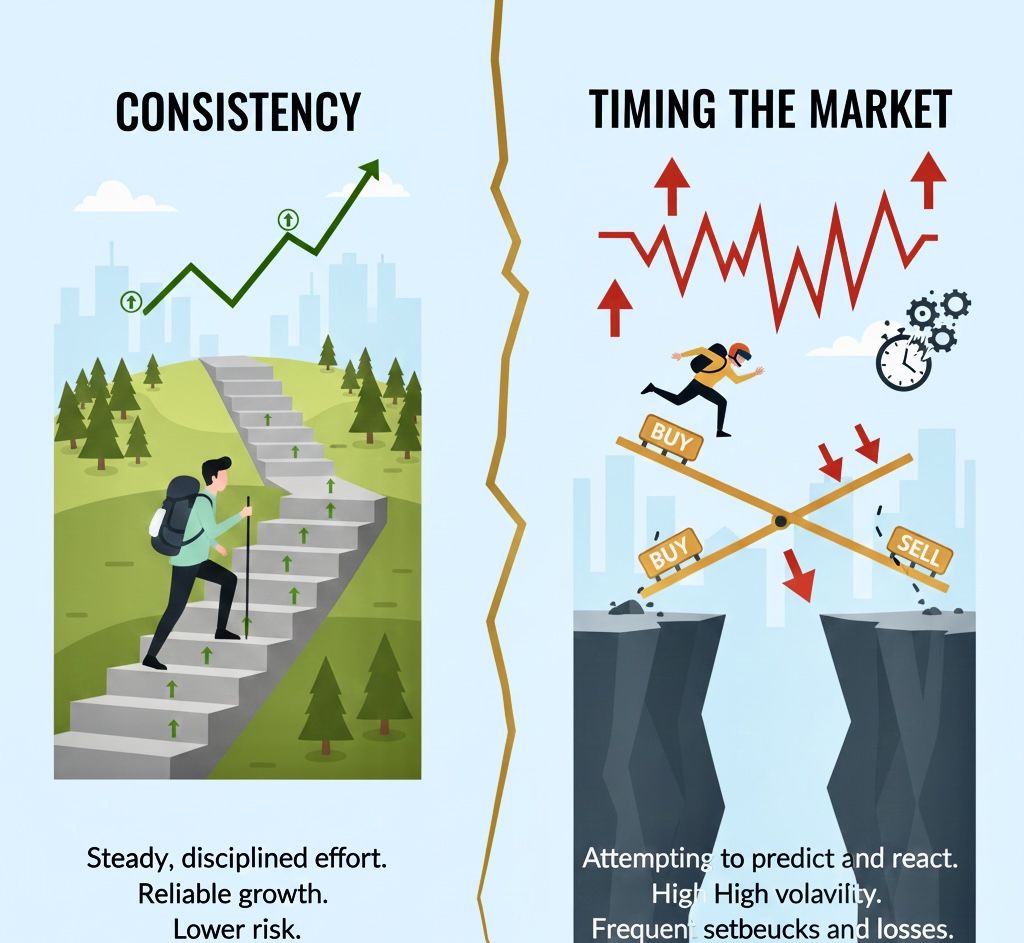
Consistency vs Timing: Why Waiting for “The Right Time” Keeps You Poor
Many people don’t fail financially because they make bad decisions — they fail because they never make one at all.
Almost everyone wants to invest. Very few actually do. And the reason is rarely lack of information or opportunity. It is waiting.
Waiting for the market to fall. Waiting for the “right moment”. Waiting until things feel certain.
That wait often lasts years — and quietly costs more than any market downturn ever could.
The Comfort of Waiting
Waiting feels responsible. It feels intelligent. It gives the impression of control.
Consider Michael.
Michael followed financial news closely. He understood markets were volatile. Every time he considered investing, there was a reason not to: interest rates were rising, inflation was high, geopolitical tension was in the headlines.
“I’ll start once things settle,” he told himself.
They never did.
Years passed. Markets rose, fell, recovered, and grew again. Michael remained on the sidelines, increasingly convinced he had “missed it”.
His biggest mistake was not losing money — it was never allowing time to work for him.
The Quiet Power of Consistency
Now consider Aisha.
Aisha did not try to predict markets. She did not follow daily headlines. She committed to investing a fixed amount every month, regardless of what was happening.
Sometimes she invested at highs. Sometimes at lows. She did not celebrate the highs or fear the lows — she stayed consistent.
Over time, something powerful happened. Volatility became irrelevant. Compounding took over.
While Michael waited for certainty, Aisha allowed uncertainty to work in her favour.
Why Timing Fails Most People
Market timing assumes two things: knowing when to get in, and knowing when to get out. Most professionals struggle to do this consistently.
Behaviour makes it worse.
- People wait too long to enter after a fall
- They panic and exit during downturns
- They chase performance after markets rise
The result is predictable: buying high, selling low, and blaming the market.
In reality, the issue is not timing — it is emotion.
A Lesson From Warren Buffett
“The stock market is a device for transferring money from the impatient to the patient.”
— Warren Buffett
This single quote captures the heart of investing success. Markets reward patience, not prediction.
Impatience shows up as waiting for perfect conditions. Patience shows up as staying invested through imperfect ones.
What Waiting Really Costs
The cost of waiting is not obvious — which makes it dangerous.
Missing just a few strong recovery days can dramatically reduce long-term returns. And those days often occur when fear is highest.
By the time confidence returns, much of the growth has already happened.
This is why consistency outperforms timing over decades.
How to Break the Waiting Habit
1. Automate the Decision
Automation removes emotion. When investing happens automatically, fear and hesitation lose their influence.
2. Focus on Time, Not Headlines
Markets fluctuate. Time compounds. The longer money is invested, the less short-term noise matters.
3. Accept Imperfection
There is no perfect entry point. The goal is participation, not precision.
4. Redefine Risk
Risk is not short-term volatility. The real risk is failing to outpace inflation and delaying compounding.
Consistency Is a Behavioural Advantage
Consistency feels boring. It lacks drama. It lacks stories.
Yet over time, it quietly separates those who build wealth from those who remain spectators.
If you want to explore how consistency and time work together, read our article on starting early and compound growth.
The Thought Worth Sitting With
Most people are not waiting because they are cautious. They are waiting because they want certainty in a world that does not offer it.
Wealth is built by acting despite uncertainty — not eliminating it.
Consistency turns uncertainty into an advantage. Waiting turns it into an excuse.
Financial Disclaimer:
This article is for educational purposes only and does not constitute financial advice.
Investing involves risk, and capital is at risk.
Follow Shares Investment Lifestyle for calm, long-term investing insight:
👉 Facebook |
👉 Instagram
It’s more than money, it’s a lifestyle.
This guide is general education, not financial advice. Investments can fall as well as rise. If you are unsure, speak to a regulated financial adviser.